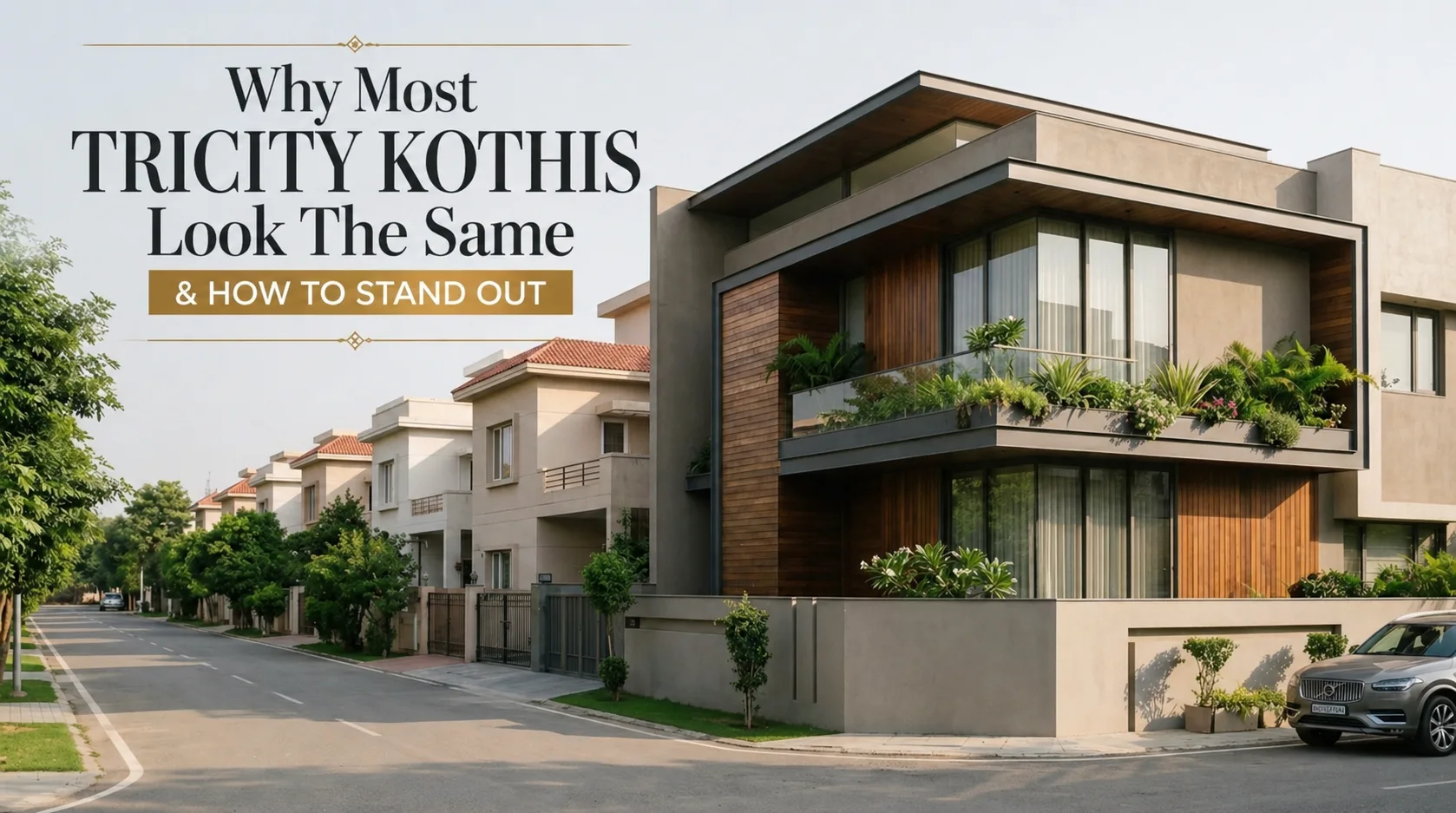
The Tricity area, consisting of Chandigarh, Mohali, and Panchkula, has a reputation for its planned sectors. The clean layouts and premium residential living in these cities make it a place worth living in. Over the years, the kothi culture which means independent house living has become famous. This has in fact become a defining feature in regard of this region’s real estate identity. But this comes with a growing concern where homeowners and designers start to notice one thing, it’s not hard to see that most Tricity kothis actually look strikingly similar.
You may see from identical façade styles to repetitive elevation designs. All of that is proof that the architectural landscape mostly lacks individuality. This raises a very important question: Why Most Tricity Kothis Look The Same & How To Stand Out in today’s competitive real estate environment in India?
Tricity Real Estate Reality: A Quick Data Insight
The demand for residential houses in Tricity has risen greatly, causing quick and repetitive patterns of development. As per an ireport on regional real estate expansion, almost 350+ housing societies have emerged in the cities of Mohali and Panchkula in the last decade, whereas Chandigarh is quite restrictive in this regard.
Source: Hindustan Times Real Estate Analysis
An imbalance like this between demand and design diversity is actually a big reason why there’s a lot of repetitive kothi architectures in the Tricity region. Thisis why it becomes important to hire professionals who offer architectural design services.
Why Do Most Tricity Kothis Look The Same?
Standardised Builder Designs
Reliance on pre-approved builder plans is in fact one of the primary reasons for uniform kothi design. You’ll see in Chandigarh, Mohali and Panchkula where developers mostly just reuse similar layouts. This is done to reduce architectural costs as well as approval delays.
As a result, most homes follow:
- Similar front elevations
- Repetitive balcony patterns
- Standard gate and boundary wall designs
Plot Regulations & Municipal Guidlines
Planning for urban development in Tricity is highly regulated. Although this helps maintain discipline, it reduces freedom for architectural innovations. Strict building regulations in terms of FAR, heights, and setbacks make houses appear standard.
You can see this the most when separate kothis are made according to municipal guidelines and not by customized architecture.
Copy-Paste Architectural Trends
In India’s Tier-1 and Tier-2 cities, inspiration for designs is drawn from buildings that are close by. After an appealing kothi design becomes popular, it is duplicated across several societies.
Consequently:
- Stone-clad façades
- Entrance gate designs using pillars
- Popular color combinations such as beige, cream and brown
Cost-Based Construction
Construction costs actually matter more than innovative designs for most homeowners. Contractor design models save money, but they also lack creativity.
In the case of Mohali and Panchkula, where there have been fast developments, mass construction has prevailed over individual architecture.
Lack of Design Consultation
A significant percentage of kothis in India do not receive professional consultations by architects, which makes the house utilitarian, but all look alike.
Why Standing Out Matters in Today’s Tricity Real Estate
Design is becoming the core of differentiation which makes sense as luxury homes are gaining popularity in Tricity, Today’s Indians desire:
- Premium façade identity
- Smart spatial planning
- Sustainable architecture
- Luxury lifestyle integration
If we look at the industry experts, then Tricity is quickly turning into a lifestyle luxury homes market. This is seen with smart home designs and intelligent architecture trends.
A shift like this actually means that a generic kothi is no longer enough to really reflect status, taste or investment value.
How To Make Your Tricity Kothi Stand Out
Invest in a Custom Architectural Design
It’s not enough to just rely on standard contract plans, you have to actually hire an architect. Choose one who can design a façade that reflects your personality and lifestyle.
Focus on:
- Unique elevation geometry
- Balanced material combinations
- Functional luxury planning
- Modernise Your Façade Design
Start by upgrading from traditional stone heavy designs to contemporary architecture.
These are the popular trends:
- Minimalist glass façades
- Vertical greenery walls
- Mixed material finishes (wood + metal + concrete)
Add Smart Home Integration
Modern kothis in India evolving very well into tech enabled homes. You can increase perceived value by adding automation.
Examples:
- Smart lighting systems
- App-controlled security
- Automated curtains and climate control
Focus on Landscaping & Outdoor Identity
Exteriors carry as much importance as interior spaces in Tricity which a lot of homeowners don’t know. An effective garden or driveway design will entirely change how your house looks.
Here are some pointers to consider:
- Water fixtures or fountains
- Nativescape landscaping
- Outdoor lighting
Break the Color Scheme
Do not rely on clichéd earth tones. Opt for:
- Monochromatic schemes
- Accent walls
- Textured finishes
This will make your kothi unique amidst crowded residential colonies.
Emphasize Vertical Design Features
Given that many Tricity dwellings are made with similar layouts, vertical features could work here too.
These could be:
- Two story front doorways
- Staircases that have been designed and are visible from the facade
- Different layers of balcony protrusions
The Future of Kothi Design in Tricity
Residential architecture trends in Chandigarh, Mohali and Panchkula are moving toward these:
- Architecture inspired by luxury
- Sustainable home building techniques
- Living in smarter environments
- Tailor made houses rather than mass-produced ones
Individuality in design is becoming a big real estate asset now. This happens as land becomes limited and lifestyle expectations increase.
Conclusion
It’s no coincidence that almost all the Tricity kothis resemble each other. This is all because of uniformity in planning, economical construction, and absence of architectural input. Home owners have an excellent chance to rethink their living spaces. This is possible with evolving buyer expectations and increasing demand for luxury properties in India,
With the help of well-thought-out architectural inputs, modern building materials, and customized architectural elements, you can make your kothi unique and valuable in more ways than one. Our emphasis at Design de Maison is precisely on this.
Frequently Asked Questions
Q – What is the main reason most Tricity kothis look identical?
A – The reason behind this trend is the standardization of design and planning as well as municipal rules and regulations governing construction in Chandigarh, Mohali, and Panchkula.
Q – How can I make my kothi stand out in Tricity?
Some ways include the use of custom architectural plans and designs, smart home technology and facilities, unique façades, and landscaping.
Q – Are custom kothi designs allowed in Chandigarh and Mohali?
Yes, however, custom designs will have to conform to certain building bylaws as well as FAR limitations.
Q – Why is architecture in Tricity so repetitive?
This is due to the expansion of real estate along with cheap and fast construction techniques.
Q – Does façade design affect property value in India?
Yes, façade design has an effect on the resale price and overall value of a kothi.
Q – Is there a boom in luxury real estate in Tricity?
Yes, Tricity has turned into a hub for luxury real estate.
 Home
Home Portfolio
 Call Us
 Whatsapp
 Contact Us
 Call Us
 Whatsapp