
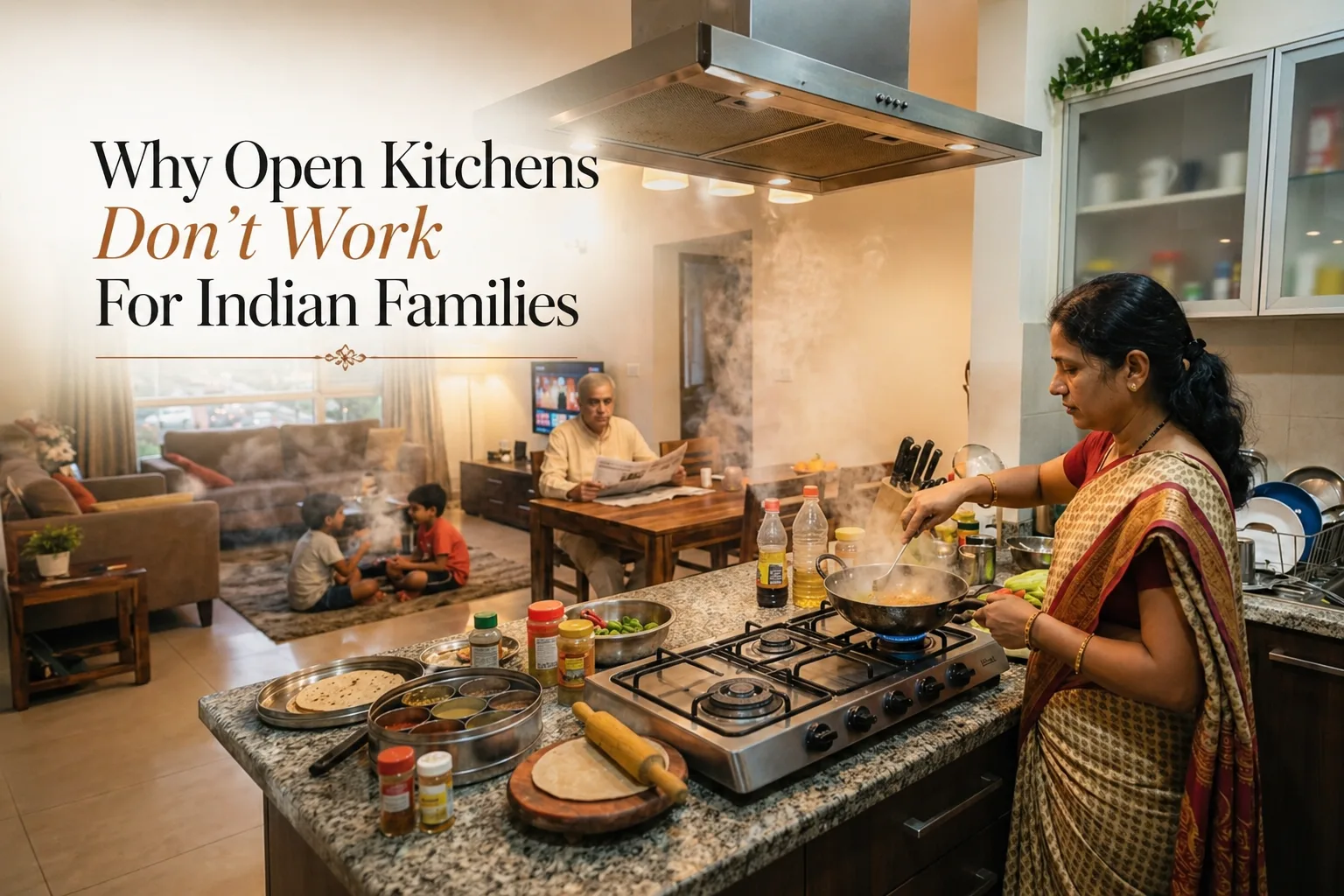
One of the most talked-about trends in modern Indian interior design is open kitchens. If you walk into any newly built apartment in cities like Mumbai, Delhi, or Bangalore, one thing is common. You’re definitely seeing a sleek open kitchen flowing into the living space. There’s no doubt that this looks contemporary, spacious along with visually appealing. Many homeowners notice very fast that there’s a gap between aesthetic appeal and real-life functionality in everyday practicality.
Design De Maison regularly deals with clients who chose an open layout in their kitchen at first, but ended up being unable to use it properly. In this blog post, we explore why open kitchens don’t work for Indian families.
The Rise of Open Kitchen Design in India
The trend of open kitchens in India is largely because of the influence of international designs and limited space in the city areas. Real estate developers use this concept in order to enhance the feeling of space within a limited area where walls act as barriers. This layout in fact helps make small apartments feel a lot more lager and brighter. Natural light travels freely without walls which makes the home seem more connected.
Although this layout works perfectly for nuclear families who do not require much time in the kitchen, most Indian families spend a lot of time in the kitchen area throughout the day. So for Indian families, this is a high activity area.
Key Statistics You Should Know
If we look at the recent insights, then there’s a disconnect between modern interior design trends and usability:
- Quite many people in urban India choose closed or semi-open kitchens following problems associated with open kitchens.
- Odor dispersion, noise, and cleaning emerge among the most frequent problems that come up. Source: House Gyan
- Quite often, people have to purchase chimneys with high capacities in order to remove smoke. Source: ACORDE
Findings like these open up the idea that open kitchens in India mostly need extra investment to work properly.
Why Don’t Open Kitchens Work for Indian Families?
Indian Cooking Is Intensive and Frequent
Indian cooking is done in a manner where elaborate steps need to be undertaken. Be it deep frying onions, making curries, baking breads and even doing snacks. Processes like these involve heat, oil and strong spices.
The effect of such activities will be:
- The smell of cooking will go straightaway
- Oil particles get accumulated in the entire room
- Smoke moves out into the living room
One of the major reasons why open kitchen doesn’t work for Indians is because of this. Indian cooking needs containment which isn’t really the case with Western cooking, as it is lighter.
Odour and Grease Spread Across the House
Even after installing the chimney, it is not easy to stop all odours from emanating from the kitchen. The smell from dishes such as tadka dal, fish fry, and masala curries can stay for long hours.
Over time, this would result in:
- The curtains absorbing odours
- The sofas catching grease
- The walls needing regular cleaning
This makes the whole house an extension of the kitchen.
Ventilation Challenges in Indian Homes
Indian apartments normally do not have effective ventilation systems installed. A normal chimney may be inadequate when cooking heavily.
In order to ventilate an open kitchen successfully, one has to use:
- Efficient suction chimneys
- Other forms of exhaust facilities
- Cross ventilation
Otherwise, heat will build up within the kitchen and become uncomfortable, particularly in summer.
Noise Becomes a Daily Disturbance
Kitchens in India are not quiet places. These are some of the activities that take place regularly:
- Usage of mixer grinder
- Sounding of pressure cookers
- Utensil movements
While in the enclosed kitchen, the noise is kept inside. However, in the case of an open kitchen, the noise joins the rest of the household routine.
Constant Visibility of Clutter
Indians use many implements, components, and processes while preparing their food.
- In the case of an open kitchen design
- Clutter will always be visible
- Immediate cleaning becomes a necessity
The need to keep everything spick and span all the time arises.
Such a setup can cause stress for people with tight schedules or those who have many visitors.
No Privacy in Day-to-Day Activities
Privacy is essential for Indian families. The kitchen is usually a private space in which members of the household or even helpers perform their daily activities.
With open kitchens, there is no privacy left because everything becomes visible to visitors. This makes the activity quite inconvenient for some families.
Distribution of Heat in the Living Areas
Preparation of meals leads to production of considerable heat. In the open-plan design:
- Heat disperses into the living area
- The cooling effect is reduced
- Costs go up
It is a serious issue in the tropical Indian environment.
More Maintenance Efforts Required
In open kitchen spaces, maintaining the cleanliness level is comparatively harder than in closed kitchen areas. The process of cleaning is not confined to a particular place but is spread throughout the house.
Most homeowners complain about:
- Dusting of furniture frequently
- Frequent cleaning
- Wear and tear of furniture quicker
When Can Open Kitchens Work In India?
Despite all of these challenges, open kitchens can work in India in some situations:
- Homes with minimal or occasional cooking
- Small nuclear families
- Studio apartments or compact spaces
- Households that prefer modern aesthetics over heavy cooking
But it’s a must that you have proper planning and ventilation even in these cases.
Better Alternatives for Indian Homes
A lot of designers now recommend hybrid solutions instead of fully open kitchens. This is what combines aesthetics along with practicality and is inspired very heavily by contemporary house design ideas.
Semi-Open Kitchen Design
Through the use of glass screens or slide windows, you can achieve the visual appeal of an open kitchen along with acoustics control.
Smartly Designed Closed Kitchens
This alternative provides the ultimate efficiency for Indian kitchens since it is aesthetically appealing and efficient at the same time.
Partially Open Kitchen Spaces
In this case, you can separate the kitchen space using half walls, breakfast bar or island design.
Conclusion
Open kitchens can look elegant and modern but they mostly fall short when they’re adapted to Indian lifestyles. A combination of frequent cooking, strong flavours and family-oriented living makes fully open layouts a lot less practical.
The key takeaway is very simple: all you have to do is design your home on the basis of how you live. A kitchen is supposed to support your daily routine and not just complicate it. Blending traditional and modern interior design styles effectively also works here.
At Design De Maison, we believe in making spaces which are both beautiful as well as functional. They are very much tailored for Indian homes and families.
FAQs
Q – Why do open kitchens fail in Indian homes?
A – Open kitchen fail mostly due to strong cooking smells, noise, lack of ventilation and high maintenance requirements.
Q – Are open kitchens suitable for Indian cooking?
A – They aren’t perfect for traditional Indian cooking but involve heavy use of oil spices and heat.
Q – What problems do open kitchens cause?
A – Some common problems include odour spread, visible clutter, noise disturbance and increased cleaning effort.
Q – Which kitchen layout is best for Indian families?
A – India is where closed or semi-open kitchens are more practical as they contain smoke, heat and mess effectively.
Q – Can open kitchens be modified for Indian homes?
A – Yes, you can improve functionality by using glass partitions, strong chimneys and hybrid layouts.
Q – Is a semi open kitchen a better option?
A – Yes, it offers a balance between openness as well as practicality which makes it perfect for Indian households.
 Home
Home Portfolio
 Call Us
 Whatsapp
 Contact Us
 Call Us
 Whatsapp