
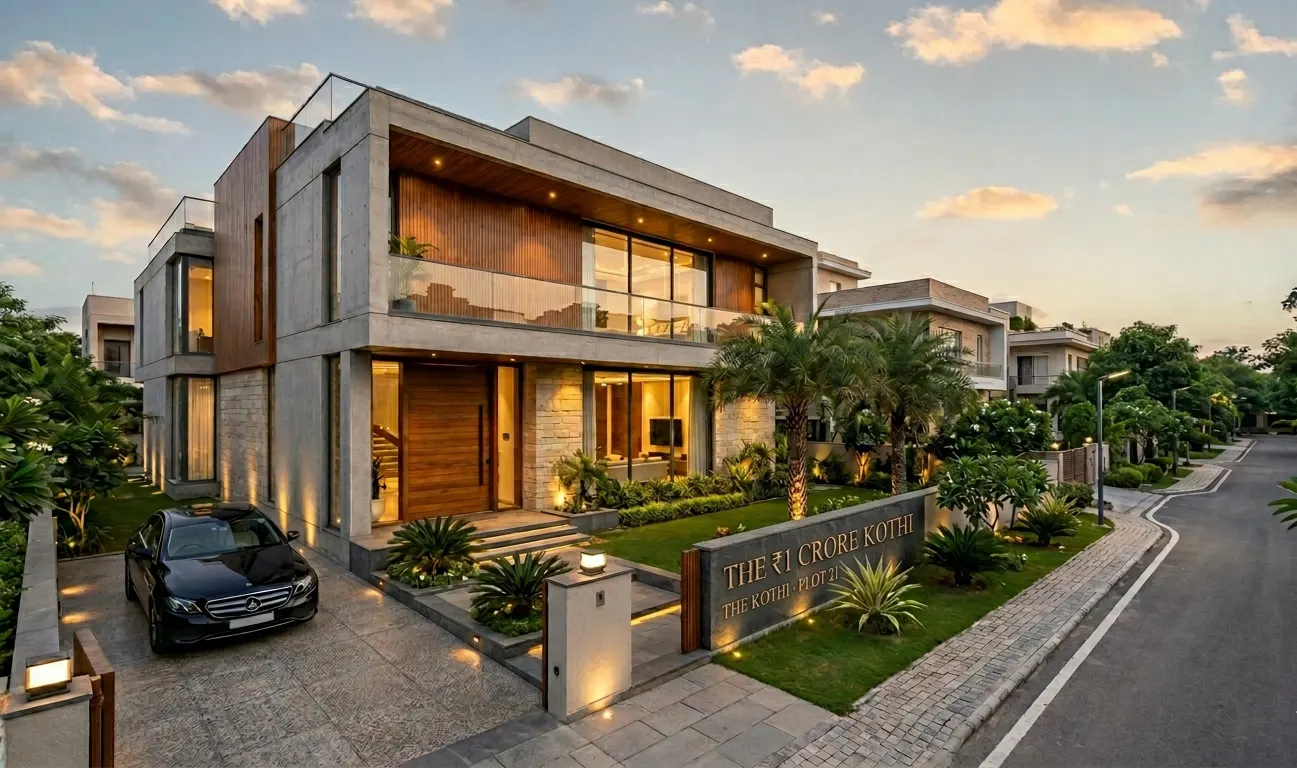
Rapid changes have taken place in India’s residential environment. In recent years, an Indian homeowner does not consider a house only as a source of earning from the property. A modern owner of the real estate considers their house to be more like the representation of their architectural preferences, comfortable lifestyle and social status. As a result, such phenomena emerge in India’s real estate market as the rise of the ₹1 crore kothi.
Starting from luxury independent homes in Delhi NCR and ending with contemporary kothi designs in Punjab and modern villas in Bengaluru, there is a visible tendency among modern Indians to invest into aesthetically pleasing and sophisticated architectural objects.
What is even more interesting about the evolution of the ₹1 crore kothi trend is its underlying design economy. It is the convergence of architecture, interior design, intelligent systems, and superior building materials which creates unique living experience for its inhabitants.
At Design De Maison, we believe that luxury interior designing of homes in India is no longer just about being luxurious. Homeowners today desire intelligent designs, aesthetically pleasing elements, sustainable buildings, and interior solutions which make their lives better.
This blog discusses the reasons behind the emergence of the ₹1 crore kothi as an important aspirational symbol in India and what impact design has on luxury architectural projects.
India’s Premium Real Estate Market: Important Numbers
There have been some impressive developments in India’s premium real estate market over the past years, particularly in the ₹1 crore plus bracket.
According to a recent JLL India housing report:
- Property sales above ₹1 crore contributed around 62-63% of all housing transactions in 2025
- Demand for premium property remained resilient amidst market changes
- The ₹1.5 crore-₹3 crore range houses became one of the best performing segments
- Customers were showing greater preference for premium designed standalone houses
How Is ₹1 Crore Kothi Defined in Contemporary India?
Kothi is derived from the North Indian language and implies a standalone villa constructed on individual land. It allows full architectural freedom to the buyer, unlike flats and apartments that do not permit such a thing. You have no shared walls, and you are not compelled to follow the construction norms set by the builders.
With the price point of ₹1 crore, a regular kothi in 2025 can be expected to look like this:
Place of Construction: Tier-1 or Tier-2 city – Ludhiana, Jaipur, Chandigarh, Indore, Lucknow, Coimbatore, Nagpur
Area: 2,000 to 3,500 sq. ft. in an independent plot
Building: RCC construction with 3 to 4 rooms, drawing room, car porch, sometimes along with a suite at ground floor
Minimum expectation: modular kitchen, vitrified or marble flooring, video door phone, false ceiling – not upgrades anymore, but standard expectations.
This brings us to the key difference. Back in the day, a ₹1 crore kothi would be purchased just as it is and used as-is forevermore. In the present scenario, it would be purchased and further invested into professionally.
Why Is the ₹1 Crore Kothi Defining the New Face of Luxury in India?
Traditionally, the term kothi referred to standalone houses that were linked to status, legacy, and space. The new ₹1 crore kothi combines elements of:
- Modern architecture
- Luxury interiors
- Technology-driven smart homes
- Sustainability
- Lifestyle-centric designs
In various Indian cities, homeowners are shifting towards homes that offer more of a personal statement and an element of prestige as opposed to basic shelter.
Another factor that has sped up this change is the current pandemic situation. Remote work culture meant that people preferred to buy bigger houses with:
- Study areas
- Open floor plans
- Healthy interiors
- Natural lights
- Spaces that could serve multiple purposes
This means that luxury interiors in India have become accessible to more than just the ultrarich clientele. Upper-middle-class families are now actively pursuing luxury interior design services.
Why 1 crore Rupees is the New Aspiration Level in India?
Rising Disposal Earnings
In recent times, the emergence of a strong professional community and the exposure of the nation to the global world have made Indians more prosperous.
Now that double-income families in cities have more disposable earnings, they can spend large amounts of money on lifestyle products like real estate.
Design Has Turned into a Status Symbol
The new age Indian home owner does not aspire for common interiors but desires unique homes.
What do today’s buyers look out for?
- Unique furniture
- Superior interiors
- Italian kitchens
- Automated solutions
- Designer lighting
- Luxurious closets
- State-of-the-art bathrooms
Interior designing has become a part of one’s identity. This is the point at which Design De Maison becomes highly relevant.
Tier-II Cities Driving Luxury Housing Boom
Chandigarh, Mohali, Jaipur, Indore, Ludhiana, Lucknow, among other cities, are experiencing a surge in luxury housing investments.
While in metros, ₹1 crore would probably just get you a small flat, Tier-II investors usually opt for independent kothis that include:
- Bigger plots
- Superior architecture
- Luxury interiors
- Outdoor landscape
- Modular kitchen
- Entertainment areas
That’s why there is such a big requirement for architectural designing services and interior turnkey solutions in India.
How An ₹1 Crore Kothi is Designed?
Premium housing has contributed towards growing the design economy of India too.
Today, a ₹1 crore house includes a network that comprises:
- Architects
- Interior designers
- Furniture makers
- Lighting designers
- Automation engineers
- Landscape architects
- Material suppliers
Luxury houses in modern days are not just built based on civil engineering alone. They are built by the art of design.
Trends Shaping the Design of the ₹1 Crore Kothi in 2025-26
There has been quite a shift in the design philosophy of the premium kothi. Four major trends dominate at present:
Where maximalism was the order of the day in the past, Quiet Luxury is the new norm. The use of warm neutral tones, natural stones, linen furnishings, and subtle architecture is characteristic of this generation that is done with the excesses of its predecessor.
Biophilic Design emphasizes bringing nature indoors. In today’s design projects, one can expect large picture windows, interior courtyards, living walls, water features, and natural woods.
Hero Room: The Kitchen. The premium kothi of 2025-26 sees the kitchen emerge as the centerpiece. Today’s Indian home wants its kitchen furnished with waterfall islands, integrated appliance systems, under-cabinet lights, and European fittings.
Smart Homes have arrived here too. Automation of lighting controls, app-based temperature control, and video surveillance are now minimum requirements.
Conclusion
You can clearly notice a major change in the design and housing economy of India with the rise of ₹1 crore kothi. This basically shows that this generation wants which is intelligent architecture, luxury interiors and personalisation. Long-term lifestyle comfort is also much needed now.
Moder Indian homeowners don’t just want houses whic are just made for functionality. But they want homes that tell you stories and also make experiences. A shift like this has made new opportunities for architects, interior designers and furniture manufacturers.
Design De Maison is a name that believes that luxury home design in India should not fix to one thing. It should all mix timeless aesthetics with functionality as well as individuality.
Frequently Asked Questions (FAQs)
What is a ₹1 crore kothi in India?
A ₹1 crore kothi in India is a luxury independent house worth ₹1 crore or more with modern architecture and other luxury amenities.
Why are luxury kothis getting more popular in India?
The popularity of luxury homes in India is increasing due to rising income levels, change in lifestyle preferences, remote working environment, and desire for personal space.
Which Indian cities have high demands for luxury kothis?
Some of the most demanding cities in terms of luxury houses include Delhi NCR, Chandigarh, Mohali, Bengaluru, Hyderabad, Pune, Jaipur, and Ludhiana.
What are some current trends in modern luxury house architecture in India?
Some of the current trends in luxury kothis in India include sustainable architecture, minimalist interior design, smart homes, open designs, and luxury bathrooms.
Why is interior design important for property value appreciation?
Professional interior design makes properties look better in terms of function, efficiency, beauty, usability, and overall quality, leading to increased property value.
Why should owners use professionals for designing their luxurious houses?
It helps in making efficient and effective use of space while ensuring that sustainable solutions are considered in the luxury home construction process.
 Home
Home Portfolio
 Call Us
 Whatsapp
 Contact Us
 Call Us
 Whatsapp