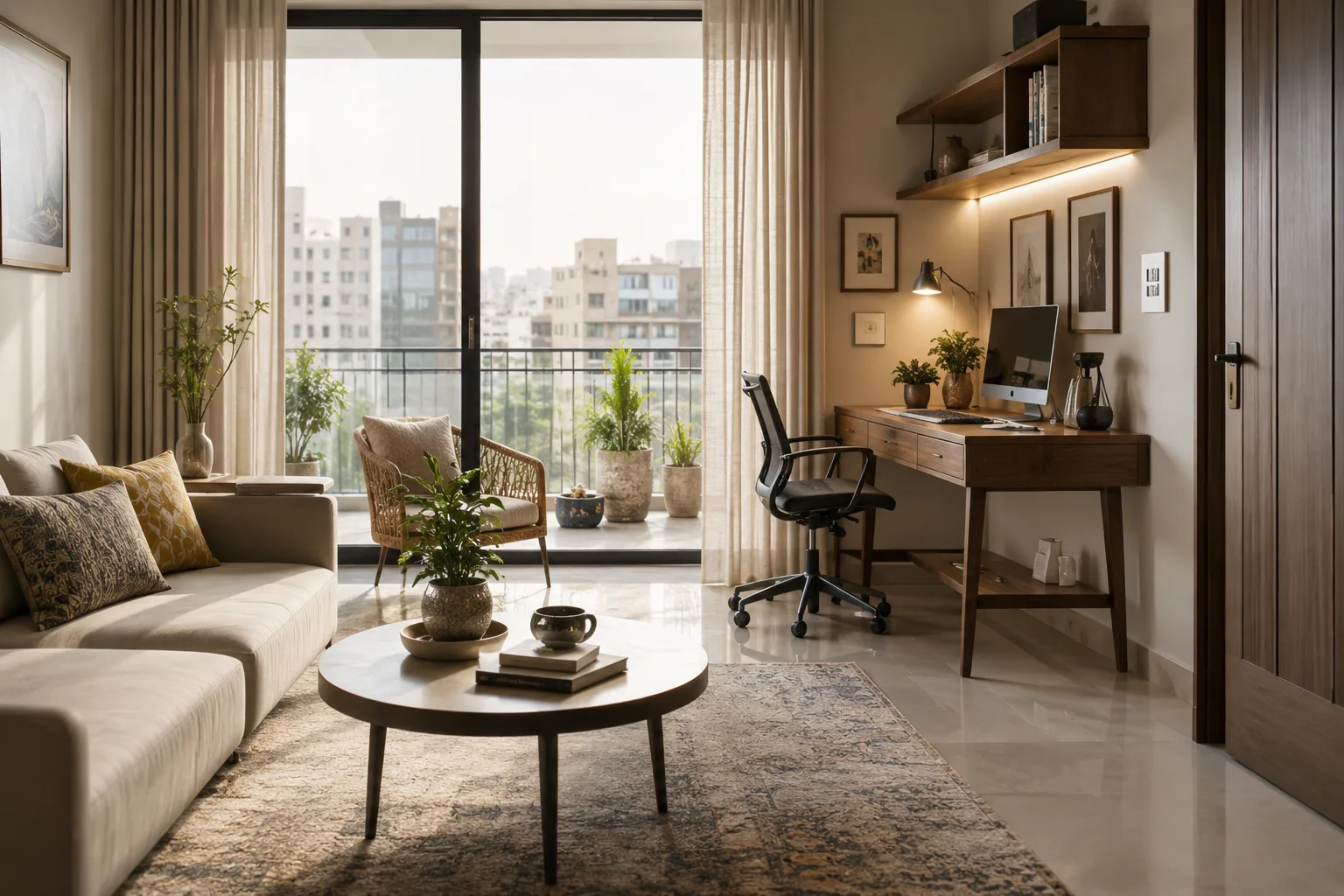
The COVID-19 pandemic didn’t just change how we live but it did a lot more in the way it changed how we feel about our homes. You’ll notice this across North India, from Delhi NCR to Chandigarh, Jaipur to Lucknow. This is where homes aren’t just places to return to at the end of the day anymore. They’ve now become offices, classrooms, gyms and basically your safe havens.
So it’s natural that a shift like this had an impact on post-COVID home design in India, which was long lasting. Today, people want homes which aren’t just beautiful but also very practical. At Design De Maison, we’ve seen this change first hand. We understand well that homeowners now want functionality, wellness and adaptability more than they ever did before.
So understanding these post-COVID home design trends in North India will help if you’re planning to design or renovate your space. This will help you make a home which fully supports your lifestyle.
Key Stats: The Shift in Indian Home Design
According to The Economic Times:
- Average apartment sizes in Indian increased 17% between 2023 and 2025
- NCR actually saw a big rise as home sizes went up by 97% since 2019
- The national average went from 1,140 sq. ft. 2019 to about 1,650 sq. ft. in 2025.
What this really tells us is simple:
Space matters a lot more now than it ever did before. It’s no longer a luxury to have bigger and more flexible homes now. They’re actually becoming the norm in post COVID India.
What Changed Permanently With Post-COVID Home Design In North India?
Hybrid Homes: Work From Home is Here to Stay
Do you remember the days where working from your dining table was only a temporary solution? Those days are gone.
Designing for hybrid homes is one of the most influential post-COVID interior design trends in North India. It requires spaces to serve different purposes depending on the time of day.
Rather than making adjustments, people are now focusing on designing their homes with:
- Work stations
- Comfortable seating options
- Quiet zones
In small apartments, too, there is an intentional attempt to create a zone where concentration can be preserved.
Demand for Bigger Homes & Extra Rooms
One thing the pandemic taught us unequivocally is that having more space can mean everything.
In North India, there is an increasing preference for:
- 3 and 4 BHK living spaces
- Properties with another room for a study or utility purposes
- Living spaces with bigger balconies or utility areas
These rooms can serve several different functions, including serving as a home office, guest bedroom, or just a space to pursue other activities.
Wellness-Oriented Interior Design
The concept of wellness has become the primary focus in interior designing within modern-day India. It’s not only about maintaining cleanliness but how it impacts your overall feeling in a room.
Some features that have received more importance than ever before are:
- Abundance of natural lighting and ventilation
- Presence of indoor plants and greens
- Use of non-hazardous building materials
- Use of soothing color schemes
These features have become especially important in metropolitan areas like Delhi and Gurugram where the levels of pollution are high. In many cases, small spaces are dedicated to practicing yoga and meditation.
Versatile Spaces and Intelligent Design
Today’s houses have to be flexible; because today’s lifestyles are. No longer is each room restricted to having just one purpose. It may serve as both a work station during the daytime and entertainment center during the evenings.
Some of the design ideas include:
- Flexible partition walls
- Convertible furnishings
- Modular rooms
All of which can make life easier by allowing users to move from one function to another. Very useful for urban houses in North India.
Revival of Traditional Indian Design Elements
Another interesting thing is that homes are also connecting with tradition as they become more and more modern.
Post-COVID home design in India has actually brought back a lot of elements like:
- Courtyards
- Jaali screens
- Natural materials like wood and stone
Features like these aren’t just visually appealing but they also improve ventilation. They regulate temperature and make a stronger connection to nature. In North India’s climate, you get a balance of practicality along with cultural charm with them.
Transition From Open Floor Plans to Zoned Privacy
An open floor plan was considered the height of cool in the past years. However, coronavirus made people think differently about this. There’s a high need for privacy and quiet zones now as more people work and study from home. So as a result, a lot of homeowners now prefer:
- Semi-open layouts
- Clearly defined functional zones
- Rooms with better sound insulation
Bedrooms are evolving into personal retreats now. These spaces where you can basically unwind, work or simply take a break from the rest of the house.
Smart Storage & Decluttered Living
Remember that your home also naturally holds more when it’s doing more. And that’s where smart storage also becomes essential.
Modern homes now include:
- Built-in storage units
- Hidden cabinets
- Under-bed storage
- Multi-purpose furniture
The goal is basically to keep the spaces clean, organised and just as much stress free. Keep in mind that minimalism is still popular but it’s all driven by practicality which means less clutter and more clarity.
Technology-Driven Smart Homes
Technology is becoming increasingly involved in trends associated with home design in North India.
This technology helps make daily life more convenient for users by providing the following amenities:
- Voice-controlled lighting and other devices
- Touch-free facilities
- Smart home security
It is now possible to construct not only luxurious but also efficient homes.
Personalized & Emotion-Driven Interiors
In a world of being cooped up inside so much, individuals now crave interiors that are personal to them.
The move toward personal design is evident by the presence of interior spaces that reflect one’s own persona. It can include such features as:
- Unique pieces of furniture
- Decorations that matter
- Comfortable colors and textures
Rather than designing for their guests or for appearances, they are designing for themselves.
Extension into the Outdoors: Balconies, Terraces, and Gardens
If there’s anything we’ve learned from the pandemic, it’s the importance of going outdoors—whether it’s to the balcony alone.
In India today, an outdoor area is one of the top priorities in the design of homes after the pandemic. Homeowners are optimizing:
- Balconies
- Terraces
- Small garden spaces
They convert them into relaxing nooks, small gardens, or perhaps a working spot. You can think of them as refreshing extension of indoor living which are much needed in busy North Indian cities.
Conclusion
Home designing in North India is no longer the same and will never be again. Nowadays, homes need to serve multiple purposes, feel comfortable, and be adaptable. Hybrid work spaces, wellness-interiors, advanced technologies, flexible layouts – all these features have become an integral part of contemporary design solutions.
The emphasis has definitely moved away from the mere aesthetics of the house and towards its practicality and comfort.
This change brings new opportunities for homeowners to design a perfect house for themselves and offers designers an excellent chance to produce homes that combine both practicality and comfort. Design studios like Design De Maison help here.
FAQs
Q – What are the key post-COVID home designs in North India?
A – Some key home designs include hybrid offices, spacious homes, wellness-oriented interiors, smart homes, and multifunctional spaces.
Q – Why do people need spacious homes in India post-COVID?
A – As people require extra rooms at home to work from and study from, there is a need for more spacious homes.
Q – How has COVID impacted the concept of interior design in India?
A – In the current scenario, interior design is being planned based on practical considerations.
Q – What does hybrid home design mean?
A – Hybrid home design is related to designing rooms to use for different purposes such as working, living, etc.
Q – Is the concept of smart homes gaining popularity in North India?
A – Yes, nowadays smart homes in India have automated systems, touchless features, and voice-enabled devices.
Q – What is wellness-centric home design?
A – Wellness-oriented homes mostly focus on making a healthy environment through light, air, vegetation as well as soothing interiors.
Q – How do you design a post-COVID home in India?
A – You can design your home by considering factors like flexibility, functional areas, proper ventilation, smart storage along with natural materials.
 Home
Home Portfolio
 Call Us
 Whatsapp
 Contact Us
 Call Us
 Whatsapp