
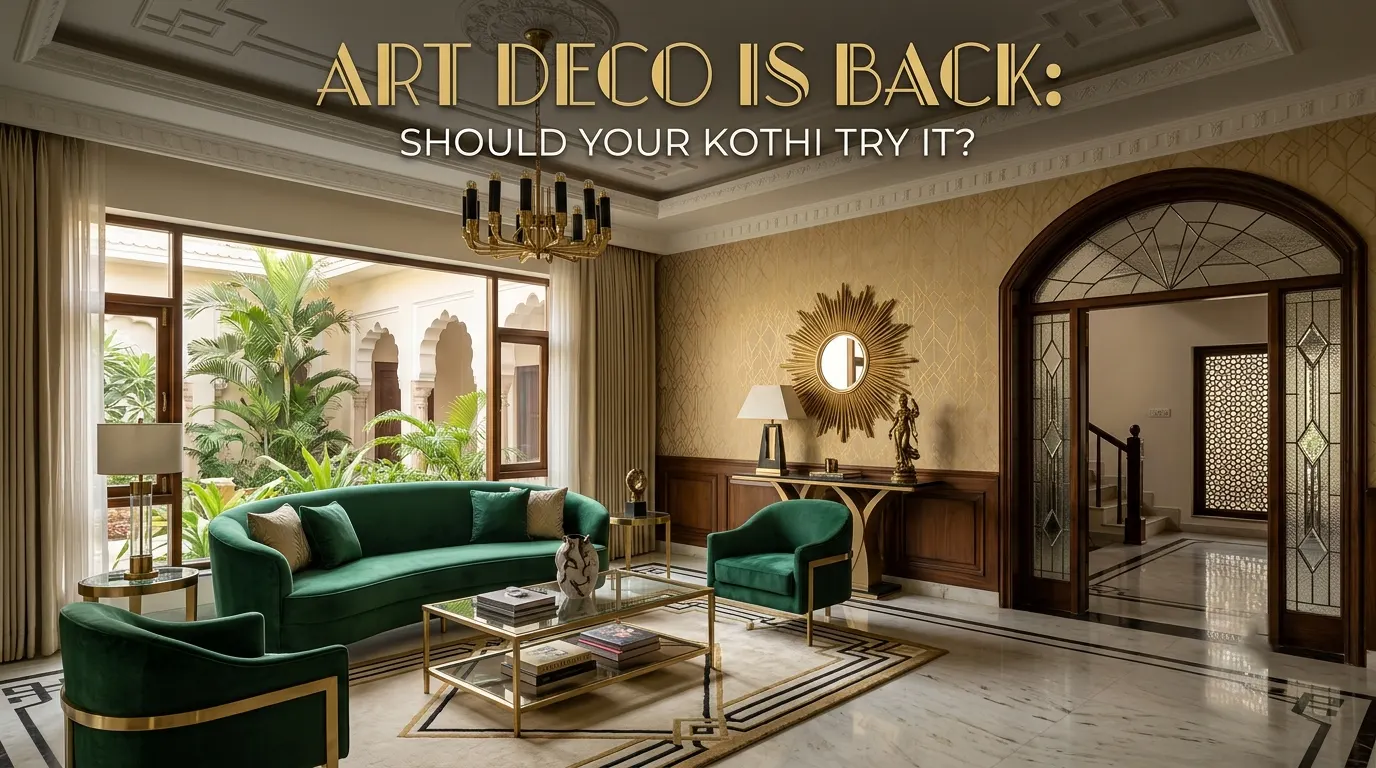
There seems to be a certain kind of charm that is slowly making its way back into our homes. Bold geometric lines, gold accents, mirrored surfaces and rich jewel tones are all part of the Art Deco style. This is a design language which was known to rule the interiors of the 1920s and 1930s. And it’s making a confident comeback now. And you may actually be sitting on just the perfect canvas to try it if you own a kothi in Chandigarh, Mohali or the wider Tricity region.
This isn’t about recreating a period museum piece. But modern Art Deco interior design for Kothi spaces is a mix of many things. It’s meant to retain the signature style glamour. Along with that, the goal is to make it liveable and contemporary without any mistakes.
What Is Art Deco Interior Design?
The origin of Art Deco style can be traced back to France, where it originated in the early 1920s. Its genesis lies in the need for artists to break away from the ornamental excesses of the Art Nouveau style and adopt the modern, streamlined look of Art Deco. The rapid popularity of Art Deco was witnessed in much of Europe and Asia; even India was not an exception. There have been many enduring examples of Art Deco architecture on Indian soil. Some of them would be the Marine Drive of Mumbai and the pastel seafront buildings of pre-independence Bombay.
Some of the key features of Art Deco design include elaborate geometric shapes such as chevrons, sunburst and fan motifs, sumptuous textures of marble, brass, lacquer and chrome, strong colours in hues such as emerald, navy, ivory and gold, mirrored finishes and opulent upholstery in velvet or silk with a sleek silhouette.
It is inherently designed to be aspirational and intended to showcase opulence and luxury. This is exactly why it so seamlessly aligns with the kothi way of life.
Why the Art Deco Revival Is Happening Now
The return of Art Deco isn’t really random. According to Zillow’s 2025 Trend Report, there were mentions of “nostalgia in home design content which rose 14% year on year. “Vintage” references climbed about 9%. Homeowners are moving away globally from cold minimalism and they are going for something more on the layered and glamorous side.
India sees the luxury residential interior design to be flourishing due to the increasing disposable income of people, while their living spaces are evolving to become more individualistic and planned. The concept of Art Deco interior design is perfectly in sync with the contemporary trends for the interiors of bungalows and kothi because of its assertiveness, sophistication, and adaptability.
This new approach to this style, known as Neo Deco, is especially suited for Indian homes. It incorporates all the classic features of art deco with geometrical sophistication and lavish use of colours, but adds modern minimalism to give it an elegant look.
How Does Art Deco Translate to a Kothi Interior?
A kothi, with its large volumes and separate spaces for both formal and private living, provides all the scope that Art Deco requires to be itself. This is how it may work in various spaces.
Living Room: The Dramatic Space
The dramatic, formal drawing room is ideal for showcasing Art Deco. Start with an imposing geometric rug in gold, ivory, and green. Use the classic sofa in velvet and lacquered wooden furniture with inlaid brass detailing. A symmetrical geometric design will go on your walls. The finishing touch is a chandelier with dramatic geometric metalwork. Use mirrors as well in small consoles for added depth. The art of Art Deco is that every piece must be worthy of the space – Art Deco may be dramatic but it’s not a maximalist style.
Entrance Foyer and Staircase
In any kothi, the entrance foyer and staircase are the architectural moments.. The use of brass or wrought iron balustrades with geometrical designs, along with the flooring with inlay work in geometrical patterns and a striking pendant light, makes a style statement straightaway. The traditional feature of a sunburst mirror above a narrow console is the hallmark of Art Deco style.
Bedrooms: Controlled Opulence
The Art Deco bedroom thrives with a controlled colour scheme that features one accent colour throughout. Velvet upholstery on the bed frame, furniture with waterfall edges or lacquered surfaces, geometric hardware on the wardrobes, and silk curtains all come together to make an elegant but not overstated interior.
Dining Space and Kitchen
For the dining space, an octagonal or round table in dark lacquered wood paired with velvet chairs and a geometric pendant fixture is a reflection of the style. This becomes a striking space. In the kitchen, go for black and white geometric floor tiles. This is where brass cabinet hardware and fluted glass panels on upper cabinets are what help you bring the style in without every comprising on function.
The Art Deco Colour Palette for Indian Kothi Interiors
The reason for this is because the materials used in the Art Deco movement have much significance in the Indian culture. Materials like brass, marble, silk, velvet, and wood are used in the Indian tradition of craft work.
As far as wall colours go, try working with ivory, teal, charcoal, or emerald. Antique gold, brass, or chrome can make for good accent finishes. In terms of furniture coverings, midnight navy velvet, dusty rose silk, and ivory boucle are all appropriate for the palette. As for flooring, marble inlays or contrasting floor tiles would be a good choice to carry the theme through to the finish line.
Where to Exercise Caution?
There are strengths to Art Deco interior design for kothi architecture, but there are dangers in neglecting proper implementation.
Scale is critical. Art Deco is intended for large dimensions. When applied to small spaces, the combination of dark furniture and geometric wallpaper may overwhelm. In limited spaces, all you need is a one statement wall, a single item of furniture or even a geometric pendant lamp.
Material quality is non negotiable. The reputation of Art Deco entirely rests on its surfaces. Low-quality chrome, poor quality lacquer, or artificial velvets would completely negate all effort put into it. Art Deco appreciates the cost of material used.
Avoid literal reproduction. It looks like dressing up if you directly copy an interior from the 1920s. Today’s best examples of Art Deco kothis interior use the language of this style and adapt it to a modern context.
Is Art Deco the Right Choice for Your Kothi?
Art Deco interior designs are appropriate for those kothi owners who wish to have an interior that feels unique, purposely stylish, and based on established principles of interior design. This type of design is particularly apt for Tricity kothis that offer high ceilings and proportionate spaces.
In case you have an inclination towards more understated or casual interiors, or if your kothi has an architecture that is modern and contemporary in nature, imposing Art Deco would not work since this would make the interiors look disjointed.
For people who like this design movement but are apprehensive about the full effect, using half measures works great; for example, incorporating the Art Deco style in the entrance foyer and drawing rooms while keeping it subtle elsewhere. An experienced designer in the Chandigarh Tricity area who knows the ins and outs of both styles would be able to guide you here.
At Design De Maison, we work across kothi interiors in Chandigarh, Mohali, Panchkula and Zirakpur. So if you’re looking to consider an Art Deci direction for your kothi, then get in touch with our team now to explore what is possible.
Conclusion
Art Deco is not a temporary trend. It is an interior design movement with 100 years of elegance to its credit. If you are a kothi owner in Chandigarh Tricity looking for an interior design that will offer class without excess, geometry without austerity, and luxury without frivolity, then you should seriously look into incorporating Art Deco interior design for kothi. It can turn your kothi into the most deliberate house in the area when you do it properly.
Frequently Asked Questions
Q1. What is Art Deco interior design?
Art Deco is a type of decorative art that came into being in the country of France in the 1920s, known for the use of geometric shapes, luxury materials like marble and brass and other metallic colours, vibrant jewel tones and mirror finishes.
Q2. Is Art Deco suitable for kothi interiors in Chandigarh Tricity?
Yes. In Chandigarh, Mohali, Panchkula, and Zirakpur, kothis provide the necessary space and height for Art Deco to be able to flourish comfortably without coming across as claustrophobic or over-the-top.
Q3. What are the key elements of an Art Deco kothi interior?
These include the use of geometry in design (chevrons, sunbursts, fans), brass or gold detailing, marble floors with contrasting inlays, jewel-coloured velvets and silks for seating, furniture made of lacquer with streamlined designs, and mirrors. The use of lighting is very important in creating the look, using geometric chandeliers and pendant lights.
Q4. What colours work best for Art Deco interiors in Indian homes?
Effective combinations are those that use warm ivory, dark teal, green and charcoal as the main colours, while antique gold, brass and chrome can be used for accents. White is not recommended since it lacks warmth.
Q5. What is Neo Deco and how does it differ from classic Art Deco?
Neo Deco is simply an up-to-date take on Art Deco. It incorporates all of the elements of the latter but adds touches of minimalism and modern design to it. It is thus a more comfortable and less imposing style that is more appropriate for today’s homes that desire the style of Art Deco.
Q6. Can Art Deco be applied partially rather than throughout a kothi?
Of course. Using the Art Deco style in key areas such as the entrance and drawing room, but using minimal styles in private rooms, will prove to be both efficient and effective. This way, there won’t be an overwhelming use of the style.
 Home
Home Portfolio
 Call Us
 Whatsapp
 Contact Us
 Call Us
 Whatsapp