
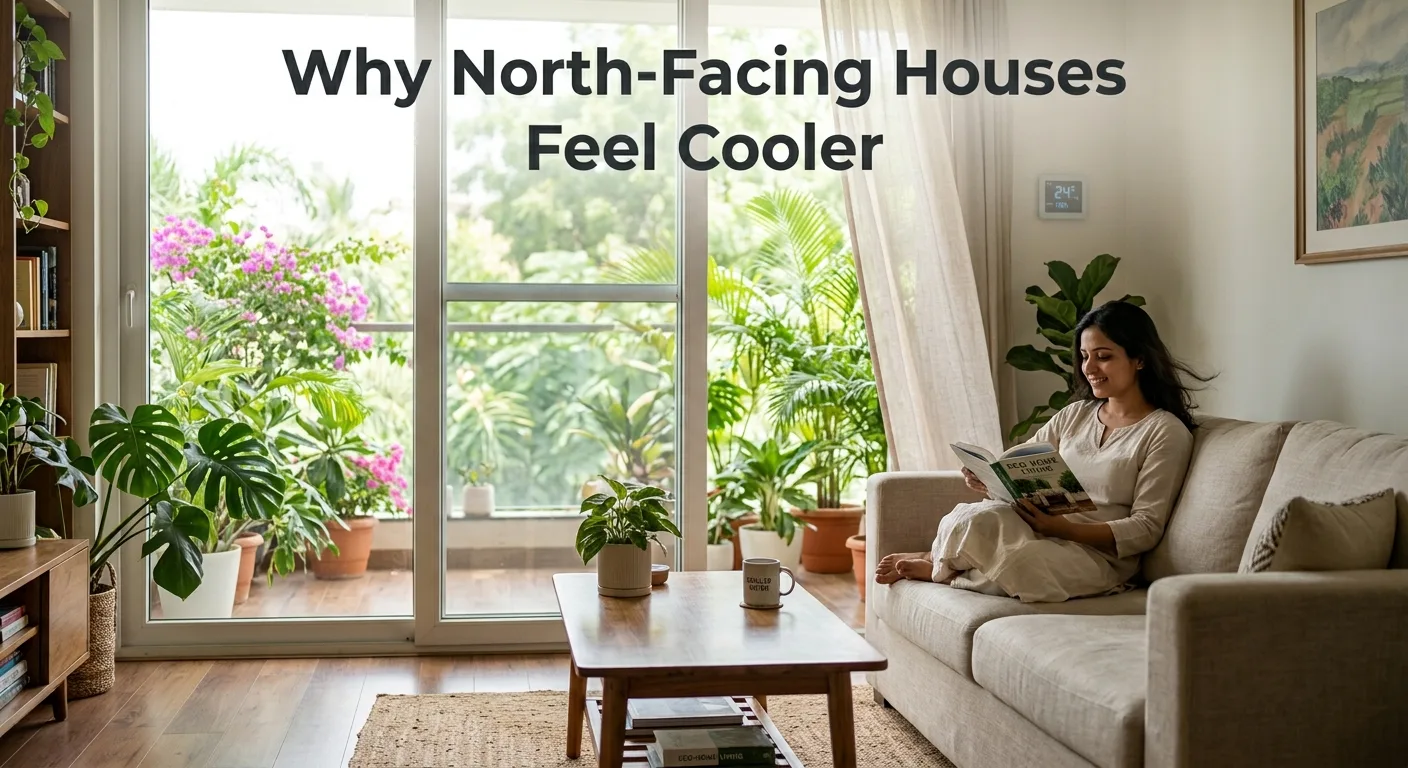
Most people focus on floor plans, interiors and aesthetics whenever they’re planning a new home. One factor that’s very often overlooked is the orientation which is the direction your home faces. So if you’ve ever wondered why north-facing houses feel cooler, it’s because of how the sunlight interacts with the buildings throughout the day.
Summers are intense in India and the direction your house faces can affect the indoor temperatures, natural lighting and even electricity bills. Although there is no orientation that can be regarded as the best for all purposes, north-facing houses generally enjoy softer sunlight for the majority of the day. Here at Design De Maison, we assess the pattern of the sun’s movement before creating every design, thus our clients in Chandigarh, Mohali, Panchkula, Zirakpur, Kharar, New Chandigarh and Derabassi enjoy comfortable homes.
Quick Facts: Home Design & Energy Efficiency in India
- Energy consumed in buildings is roughly one-third of the overall energy consumption of India, with the requirement for cooling increasing year on year.
- Design based on climatic conditions helps in minimising the requirement of artificial cooling.
- Orientation, shading, and ventilation are some of the key concepts that are recommended for energy-efficient houses by BEE and ECBC.
What Does a North-Facing House Mean?
A north-facing house is one where the main entrance faces north. Inthe northern hemisphere location, the sun travels across the southern part of the sky. Hence, the northern walls of such houses will receive less direct sunlight than the south or west facing walls.
This doesn’t mean that the home remains dark. A north-facing home can enjoy bright and diffused daylight while avoiding excessive heat with the right architectural planning.
Why North-Facing Houses Feel Cooler: The Science Behind It
Reduced Direct Sunlight
The primary reason for the low temperatures inside the northern-facing houses lies in the lack of direct exposure to afternoon sunlight.
In cities such as Chandigarh, Mohali, Panchkula, and Zirakpur, houses with western facades tend to absorb more heat due to the harsh rays of afternoon sun, making them warm even after sunset hours. Houses facing in the northern direction experience mild and indirect sunlight.
Lower Heat Gain During Summer
The summer temperature in North India generally crosses 40°C mark. A lesser exposure to solar radiation translates into lesser heat absorbed by the house.
When combined with the following elements,
- Insulating walls
- Energy-efficient windows
- Roof treatment
- External shading
it makes a north-facing house more pleasant to live in.
Better Natural Daylight Without Glare
North facing houses are considered dark, but the truth is that these houses usually have a constant flow of glare free daylight all day long.
These houses are suitable for:
- Living rooms
- Home offices
- Studios
- Reading rooms
- Study room for children
The preference of architects for north light is because of its softness and evenness.
Improved Energy Efficiency
The primary advantage associated with opting for a north-facing house is that there is less reliance on the air conditioner.
The cooler temperatures inside usually lead to:
- Decreased cooling expenses
- Better energy efficiency
- Lower electricity bills
- Enhanced comfort
In combination with passive solar principles, this leads to considerable savings in the long run.
North-Facing vs South-Facing vs East-Facing vs West-Facing Houses
| Direction | Sunlight | Summer Heat | Best For |
| North-Facing | Indirect | Low | Home offices, living spaces |
| East-Facing | Morning sun | Moderate | Families who enjoy morning light |
| South-Facing | Maximum daylight | Moderate to High | Winter warmth (with shading) |
| West-Facing | Afternoon sun | Highest | Needs strong insulation and shading |
A comparison like this matters just as much as the best house direction in India debate itself. Each of the orientation suits different priorities.
Is a North-Facing House Right for You?
The perfect orientation depends on the following factors based on the plot type:
- North orientation is suitable for small and corner plots because it makes use of sunlight without any heat.
- Living areas facing north with windows on other sides are appropriate for duplexes and villas.
- Orientation is not important for apartments since ventilation plays a bigger role.
- Independent houses have many options for making use of sunlight.
The appropriate orientation is not based on directions alone but on the plot, lifestyle, ventilation, and architecture.
Tricity-Specific Examples
As far as Chandigarh is concerned, north-oriented houses usually benefit from better distribution of daylight thanks to wide streets and setback regulations. In Mohali and Zirakpur, where sites are relatively small, the combination of orientation and cross ventilation assumes particular significance. As regards Panchkula, Kharar, New Chandigarh, and Derabassi, where rapid residential construction is taking place, our architects study nearby buildings first before fixing the orientation of the house.
Things to Consider Before Buying a North-Facing House
- Plot size and shape
- Neighbouring buildings and future development
- Tree cover and shading
- Ventilation potential
- Local microclimate
- Window and door placement
- Budget for insulation and glazing
7 Ways You Can Keep a North-Facing House Even Cooler
- Install roof insulation
- Use reflective exterior paint
- Add pergolas or overhangs
- Plant shade trees strategically
- Choose Low-E glass for windows
- Improve cross ventilation
- Use ventilated or cool roofs
Why Orientation Alone Isn’t Enough
A north facing plot helps but it’s the entire design which makes you comfortable. The ceiling height, thermal insulation, roof structure, construction material, ratio of glass to wall, landscaping, and ventilation system are equally important. Architects at Design De Maison follow the climate-sensitive approach instead of orientation alone since any north-oriented house will be hot otherwise due to the wrong choice of materials and inadequate ventilation.
Why Home Orientation Should Be Decided by an Architect
Every good project has to start with the thorough study of the land: path of the sun, wind direction, topography, plot sizes, and potential development of the area. This is the difference between a good looking house and one that’s actually comfortable for you throughout the year.
Mistakes People Make When Choosing a North-Facing House
- Buying just on the basis of Vastu alone
- Ignoring the ventilation planning altogether
- Bad of placement of windows
- Skipping insulation just to cut costs
- Overlooking the surrounding buildings
- Not consulting an architect before finalising it
Common Myths About North-Facing Houses
Myth 1: North-facing houses get very little sun light.
Reality: These homes receive plenty of indirect sunlight if properly designed.
Myth 2: Orientation is the key to the indoor climate.
Reality: Ventilation, insulation, roofing, and materials are just as important.
Myth 3: All north facing homes are energy efficient by default.
Reality: A badly designed north-facing house may be far from comfortable.
Why Work with Design De Maison?
Designing a comfortable home is not just about selecting the right plot direction. Our team provides residential architecture, interior design, home renovation, villa design, space planning and sustainable architecture services among others. These are all oriented to the principles of climate-sensitive planning, plot orientation study and use of natural lighting. Find out more about our team.
Conclusion
Understanding why north-facing houses feel cooler helps you make better decisions while designing the house of your dreams. Comfort is all about a good blend of proper orientation, ventilation, shading, material, and design suited for the climate. Planning a house in any part of Tricity, you should consult experts to make the most of your land, whatever its orientation may be.
Frequently Asked Questions
-
Why do north-facing houses feel cooler?
A – The north-facing houses have lesser direct sunlight falling on them in India and hence remain cooler than south or west facing houses.
-
Are north-facing houses better in India?
A – In many places in North India, particularly the Tricity area, north-facing houses are found to be more comfortable during summers.
-
Is a north-facing house good in Chandigarh?
A – Yes. The planning and road widths in Chandigarh ensure that the north-facing houses have more even distribution of light and air circulation.
-
Which house direction stays the coolest in India?
A – North-facing houses usually remain cooler, then east-facing houses since neither faces the direct glare of the sun in the afternoon.
-
Does a north-facing house get enough sunlight?
A – Yes, since the houses get consistent, non-glare indirect sunlight all day long, which makes them fit for residences and home offices.
-
Is a north-facing house better than a west-facing house?
A – Generally yes, because the west-facing houses face strong direct sunlight in the afternoon and requires better insulating and shading measures to keep cool.
-
Can architects improve the temperature of a west-facing home?
A – Yes, because with insulation, shading elements, reflective materials, and better window placement, architects can reduce heat gain in such houses.
-
Does home orientation affect resale value?
A – It can affect the resale value especially in markets where Vastu and thermal comfort are what the buyers prefer. This is done through layout quality and location matters more overall.
 Home
Home Portfolio
 Call Us
 Whatsapp
 Contact Us
 Call Us
 Whatsapp