
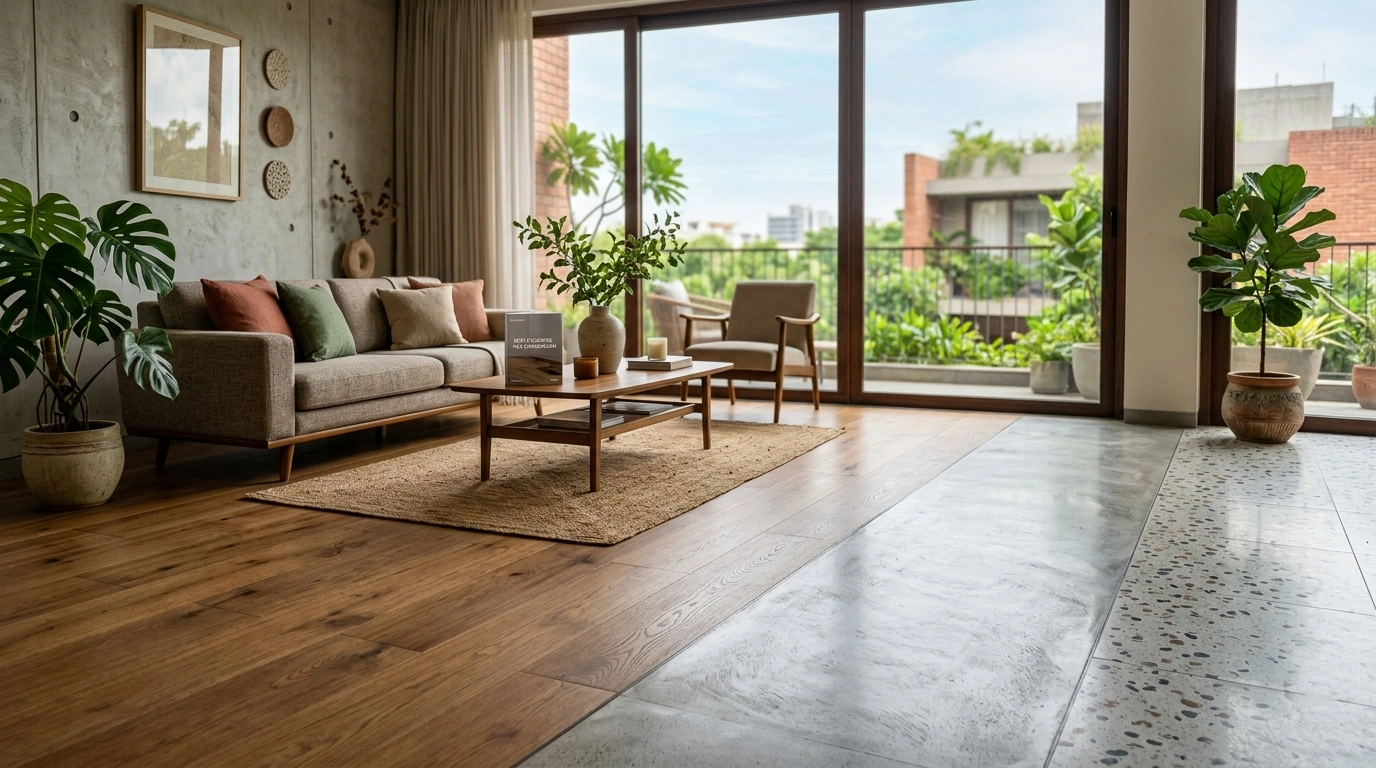
Looking for the best flooring options for Chandigarh homes but don’t really know how to start? Don’t worry, you’re not alone. Choosing a flooring material is one of the most permanent choices in a house renovation. If you do it correctly then it will add value to every room for decades to come; if done wrongly, then you’ll have to deal with the result every single day.
This guide gives you a material by material breakdown for making the right choice. Make the right call for your home and budget with the help of below listed comparisons and room-specific picks.
Why Flooring in Chandigarh Is a Different Conversation
Climate is one of the important factors that homeowners often overlook while selecting flooring. The summers in Chandigarh and the Tricity area, comprising Mohali, Panchkula and Zirakpur, reach temperatures as high as 40°C, and the winter season sees freezing cold. Not to forget, there is a monsoon period that sees real humidity. That thermal range with months of dry dusty weather means materials that look beautiful in a showroom can underperform badly here over time.
There is yet another element of complexity involved here, which is the Tricity property type. Older sector kothis tend to have high ceilings and spacious rooms where natural stone looks fabulous. On the other hand, newer apartments in places like Aerocity or Sector 82 tend to have compact dimensions, in which large-format vitrified tiles would be ideal. The right flooring for Chandigarh homes actually depends on both your property type and how you actually live in it.
Best Flooring Options for Chandigarh Homes: A Material-by-Material Guide
At a Glance – Flooring Cost and Best Use
| Material | Approx. Cost (All-in) | Best For | Maintenance |
| Vitrified Tiles | Rs 200 to 300 per sq ft | Living rooms, kitchens and bathrooms | Very low |
| Indian Marble | Rs 120 to 250 per sq ft | Formal rooms and master bedrooms | Moderate |
| Italian Marble | Rs 650 to 1,000+ per sq ft | Premium formal zones | High |
| Engineered Wood | Rs 250 to 700 per sq ft | Bedrooms and home offices | Low |
| Laminate | Rs 160 to 300 per sq ft | Budget bedrooms | Low |
| Kota Stone | Rs 50 to 120 per sq ft | Sector kothis and heritage homes | Very low |
| SPC or Vinyl | Rs 110 to 200 per sq ft | Children’s rooms and utility areas | Very low |
All of these figures include material plus labour and they are meant for the Tricity market as of 2026.
Vitrified Tiles: The Practical Default
Vitrified tiles dominate Indian homes due to their durability, waterproof nature, low maintenance requirement and the fact that they are available in all budgets. In the Tricity region, the branded vitrified tiles by Kajaria, Somany and Orientbell come in the high-end category, whereas the unbranded products cost between Rs 40 and Rs 45 per square foot. Total expenditure on flooring is estimated to be Rs 200 to Rs 300 per square foot.
In particular, vitrified tiles suit the climatic conditions of Chandigarh well. They keep cool in summer, thus making them a comfortable choice and they also resist stains or water and require no maintenance at all. Large format tiles of 800x800mm or 600x1200mm size result in lesser grout lines and a bigger looking room which are the typical choice in modern Tricity houses
One firm caveat: glossy finishes get slippery when they are wet. So look for anti skid or matte finish vitrified tiles for bathrooms, balconies and kitchen flooring.
Marble: The Luxury Choice That Demands Commitment
There is no material to quite rival the aesthetic value of marble. The Indian marbles cover a wide range with the variety found in Rajasthan called Makrana. The imported Italian varieties also have many choices available. Indian marbles like Makrana, Ambaji and Udaipur varieties costs Rs 120 to 230 per square feet, while the imported variety starts from Rs 280 per square feet onwards.
Performance is key here. Scratches by furniture, footwear, and grit become visible on the marble within a year or two, while stains left by coffee, lemon juice and tomatoes, which are acid based, are permanent if the floor was not sealed regularly. In a busy household in Chandigarh with children and pets, it is likely for marble floors to require much more maintenance than homeowners realise when purchasing them.
Where marble always earns its place without reservation: formal drawing rooms, master bedrooms and feature staircases and that is where the visual impact justifies the care. Your most sensible call for kitchens and bathrooms would be vitrified or porcelain tiles.
Engineered Wood: The Warm Middle Ground
Wooden flooring makes the ambience of a space feel warm like no other material can do so. Bedrooms and home offices feel quieter and warmer with wood floors. In Tricity, a hardwood may not be an ideal option because of the extreme variations in temperature; this causes the flooring to expand or contract over the years. An engineered wood, consisting of a wooden layer on top of plywood or HDF, gives you dimensional stability along with lesser expansion or contraction – thus making it a more suitable option for Chandigarh.
Flooring with engineered and solid woods has a cost of $380 to $820 per square foot with the installation included. Teak, oak and walnut veneers are among the popular materials for interiors of Tricity. Laminate flooring is another type that can be used as an alternative due to a low cost of $160 to $300 per square foot and scratch resistance. But here’s the catch: it cannot be refinished and does not age as gracefully as many others. But it is a reasonable starting point for a bedroom on a tighter budget
Kota Stone and Terrazzo: The Heritage Option Worth Reconsidering
Chandigarh was constructed using Kota stone. Most of the original houses in Chandigarh sectors, its public structures and the government bungalows are paved with Kota stone and that is not without reason. Mined from Rajasthan, Kota stone is one of the cheapest hard flooring material options available, with a cost per square foot ranging between Rs 50 to Rs 120. It is extremely hard wearing, naturally slip resistant and stays cool underfoot in summer. And as a plus point, it requires almost no maintenance beyond occasional polishing.
In the case of old sector kothis being remodeled by their owners, the best course of action would be to give an old look a fresh new shine rather than cover it up with a newer, costlier one. The same goes for terrazzo, which consists of marble bits bonded with cement to create a smooth surface. It is going through a revival in Tricity interiors and bridging the mid century character of the city with contemporary desig sensibilities.
Vinyl and SPC: A Practical and Contemporary Choice
The contemporary choices for stone plastic composite (SPC) and luxury vinyl tiles have evolved, making them a legitimate contender in situations where the aesthetics of wood clash with the presence of water or due to budgetary limitations. These are waterproof, wear resistant and aesthetically appealing at a price range of about Rs 110 to Rs 200 per square foot. This material can be used in children’s rooms, utility rooms and rooms on the ground floor that may experience periodic contact with water.
How to Choose the Right Flooring for Your Chandigarh Home?
However, material alone cannot determine our choice. Here are four questions to guide you in making the right choice.
Who will be using the room and how? Busy family rooms require hard wearing and easy to care for materials. For private rooms, use softer materials. Wet areas require non porous and slip resistant materials.
How much maintenance are you willing to realistically give your floor? Natural stone and marble are maintained through regular polishing and sealing. Vitrified tiles and SPC don’t need maintenance at all. Answers that are straight to the point will make this selection easy.
What does the room’s design need? Warm materials like wood tones and beiges work great for homes and casual projects. Cool materials with high contrast flooring are better for structured designs.
For how long do you intend to stay at this place? The investment of money in high quality stone or engineered wooden flooring makes sense with a twenty-year horizon. If this period is short, then the better investment will be that of properly designed vitrified tiles.
Design De Maison takes flooring as a part of interior design starting from day one. Our team caters to clients from Chandigarh, Mohali, Panchkula and Zirakpur. We provide planning for the materials used along with colour, lighting and layout to make sure everything works seamlessly right from the floor up. If you are planning to renovate your place, get in touch.
Conclusion
The best flooring options for Chandigarh homes depends on the correct alignment of the use of the rooms, climate conditions in the area and a realistic approach towards maintaining the same. Vitrified tiles are the tried and tested option for this purpose. Marble is ideal for the luxury areas. The engineered wood will bring warmth in the bedroom, which no other flooring material can provide. Kota stone and terrazzo should be considered by old Tricity houses. And lastly, SPC comes as a solution where aesthetics and practicality coincide.
Frequently Asked Questions
Q1. Which is the best flooring for a Chandigarh kothi?
A – The most suitable flooring materials for a kothi in Chandigarh is marble or vitrified tiles with large formats in formal living spaces, engineered wood flooring in bedrooms and matte vitrified tiles or non-slip vitrified tiles in kitchens and bathrooms. Kota stone is ideal if a kothi under renovation already has this floor.
Q2. Is marble flooring a good choice for Chandigarh homes?
A – Marble is a good idea for Chandigarh homes, but only when it is used in the correct areas, such as drawing rooms, master bedrooms, and stairways, where care is taken to avoid frequent staining and scratching of the marble surface.
Q3. What is the approximate cost of vitrified tile flooring in Chandigarh?
A – The approximate price of all in vitrified tiles flooring (inclusive of material and labor cost) in Tricity area comes at Rs 200-300 per square feet for branded products. The material of local manufacturer brands starts from Rs 40 to 45 per square feet with total costs being higher. Remember to allocate extra 7-10% costs for wastage and skirting.
Q4. Is engineered wood floor suitable for Chandigarh’s climatic conditions?
A – Yes, it is. Engineered wood flooring is the most suitable wood flooring option in the case of Chandigarh’s climate. This type of flooring with plywood base can better tolerate temperature fluctuations as well as seasonal changes of humidity in comparison with solid hardwood flooring. It is best to use it in bedrooms and office rooms.
Q5. Is Kota stone still a good flooring choice for homes in Chandigarh?
A – Kota stone remains a good choice especially in older sector houses which have it already. This kind of stone is very durable, has natural non-slippery properties, cool to walk on and one of the cheapest flooring material options available at Rs 50 to Rs 120 per square foot. Repair and polishing of the already installed Kota stone will always be cheaper than replacing it and gives it that authentic look.
Q6. What is SPC flooring and where does it work best in a Chandigarh home?
A – Stone plastic composite (SPC) is a rigid, waterproof man-made material that imitates either wood or stone. Its price is around Rs 110 to Rs 200 per square foot. It is suitable for use in children’s bedrooms, utility rooms and ground floor areas where wood look is preferred but wood cannot actually be used because of moisture or budget issues.
 Home
Home Portfolio
 Call Us
 Whatsapp
 Contact Us
 Call Us
 Whatsapp